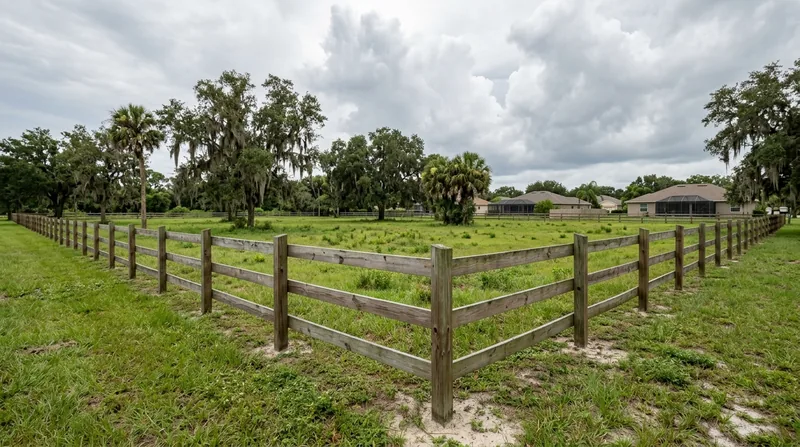




Farm fence installation in St. Petersburg requires a clear understanding of the peninsula's unique terrain, soil conditions, and weather patterns. The flat, low-lying landscape across the Tampa Bay area presents distinct challenges for long-run fencing on acreage: standing water after heavy rain, shallow water tables, salt spray near coastal properties, and wind-driven storm damage from the Gulf. Whether you are fencing pasture for horses, containing livestock, or securing a larger rural property in the greater St. Petersburg region, the fence must be built to withstand both daily moisture exposure and seasonal hurricane-force winds. We have installed ranch rail, no-climb horse fence, field wire, and pipe fencing across the peninsula since 2015, working from the ground up with proper post depth, concrete set, anti-sag bracing, and materials chosen for salt and moisture tolerance. This guide walks you through what farm and ranch fencing means here, how we build it, what it costs, and how to hire a contractor who understands the local climate and soil.
Why Farm & Ranch Fencing Matters in St. Petersburg and Surrounding Areas
St. Petersburg and the surrounding peninsula sit only a few feet above sea level, with moisture, salt air, and seasonal flooding shaping every outdoor structure. Acreage fencing on these properties faces constant moisture at the ground line, which accelerates post rot, rusts fasteners, and weakens rail connections. A fence built with standard materials and shallow post depth will fail within 5 to 8 years in this climate. Proper farm and ranch fencing here means concrete-set posts sunk 3 to 4 feet deep, pressure-treated pine or galvanized steel to resist salt and moisture, and braced corners to handle wind loads that build every June through November.
If you own acreage in Clearwater, Largo, Seminole, or the rural edges of Pinellas County, a sound fence line also protects your investment, contains livestock or horses safely, and defines property boundaries clearly. The cost of replacing a fence that failed prematurely far exceeds the cost of building it right the first time.
- Concrete-set posts prevent rot and shifting caused by moisture and seasonal ground saturation.
- Pressure-treated or galvanized materials resist salt spray and humidity on the peninsula and near coastal properties.
- Proper post spacing and anti-sag bracing keep rails straight and gates functional through wind events.
- Correct fence height and material type comply with local codes and HOA rules if deed restrictions apply.
A well-built fence on acreage holds its line, keeps horses or livestock secure, and lasts 15 to 20 years with minimal maintenance.
Key info: Fence licensing in Florida is set by county and municipality, not by the state. Requirements vary across the Tampa Bay area. Before hiring any contractor, check with your local building department to confirm what permits are needed for acreage fencing and whether deed restrictions or an HOA approval process applies. We work with local permitting offices to ensure every installation meets the rules that govern your property.
For detailed permit and code information specific to your area, visit your city or county building department website.
How We Build Farm & Ranch Fencing in St. Petersburg: A Step-by-Step Process
Every acreage fencing job starts with a site walk and a clear conversation about what the fence must do. We mark the fence line, verify setbacks and easements, call for a Florida 811 utility locate to avoid buried lines, and then build from the corners inward. Corners and gates receive anti-sag bracing and extra post depth because they carry the most load. Posts are set in concrete, not tamped, to lock them against the moisture and movement that plague this peninsula. Rails are attached with galvanized fasteners, and every connection is checked for tightness before we move to the next section.
This methodical approach keeps the fence line straight, gates operating freely, and the structure sound through years of weather and use. We also handle gate installation and repair as part of the farm fencing scope, sizing gates for equipment trailers and livestock handling.
- We confirm the fence line with you and mark it clearly before any digging begins.
- Florida 811 utility locates are called to identify buried power, gas, water, and communications lines.
- Post holes are dug 3 to 4 feet deep and set in concrete to anchor against ground movement and moisture.
- Rails are installed level and attached with galvanized bolts, screws, or nails to resist rust and corrosion.
- Anti-sag bracing is added at corners and gate openings to handle wind and livestock pressure.
- Every connection is tightened and inspected before the job is complete.
The result is a fence that stands straight, functions reliably, and holds up through the seasonal storms and moisture that define the St. Petersburg climate.
Example: A client near Seminole with 4 acres and a small horse herd needed no-climb fencing that would withstand wind and keep horses secure. We set posts 4 feet deep in concrete every 6 feet, braced the corners with diagonal lumber, and ran 2x4 rails horizontally with 1.5-inch openings to prevent climbing. The job took 3 days, and the fence has remained straight and functional through two hurricane seasons.
Farm & Ranch Fencing Methods and Materials for the St. Petersburg Peninsula
| Approach | Description | Best for |
|---|---|---|
| Ranch Rail | Pressure-treated or cedar 2x4 or 2x6 rails on pressure-treated posts, typically 3 or 4 rails high. | Horse pastures, aesthetic property lines, livestock containment on acreage. |
| No-Climb Horse Fence | Horizontal 2x4 rails with 1.5-inch vertical mesh or cable, preventing horses from climbing or catching hooves. | Horse facilities, pastures where safety and containment are critical. |
| Field Wire and Pipe | Galvanized steel posts and rails with wire mesh or field fencing, often used for cattle and mixed livestock. | Livestock containment, large acreage, cost-effective long-run fencing. |
| Split Rail Fence Installation | Rustic split rails on post-and-rail construction, typically 2 or 3 rails high, pressure-treated or cedar. | Decorative boundaries, rural properties, acreage with a traditional aesthetic. |
| Pipe Fence Installation | Galvanized steel pipe posts and rails, welded or bolted, extremely durable in salt and moisture. | Coastal properties, long-run acreage fencing, areas with severe weather or salt exposure. |
| Barbed Wire Fence Installation | Galvanized posts with multiple strands of barbed wire, typically 4 to 6 strands, tensioned and secured. | Cattle containment, property perimeter security, cost-effective livestock fencing over large acreage. |
Each method is chosen based on your animals, acreage size, climate exposure, and budget. On the St. Petersburg peninsula, we recommend pressure-treated materials and concrete post setting for all methods because moisture and salt air are constant factors. We can also discuss fence repair options if an older farm fence is showing wear.
Farm & Ranch Fencing Cost in St. Petersburg: What to Expect
Farm and ranch fencing costs vary based on the method you choose, the length of the fence line, terrain difficulty, and material type. A basic ranch fence installation in St. Petersburg typically starts at $12 per linear foot for simpler rail or wire configurations on level ground with good access. More complex jobs, such as pipe fencing, no-climb horse fence with mesh, or terrain that requires extra bracing, can run $18 to $30 per linear foot or higher. A 500-foot run of ranch rail might cost $6,000 to $10,000 depending on the rail configuration and post depth required by local soil conditions.
Factors that affect the final price include post spacing and depth (deeper posts on soft ground cost more), terrain and grading (sloped or rocky ground requires extra labor), gate size and style, and the distance from our shop to your property. We always recommend getting 2 to 3 estimates from local contractors so you can compare scope, materials, and price. For a detailed pricing breakdown and to discuss your specific property, visit our pricing page or call us at (727) 591-6938 for a free estimate.
An on-site walk is the only way to give you an accurate number because soil type, water table, tree roots, and access conditions all affect labor and material use. We respond to estimate requests within 24 hours and never charge a fee for the initial consultation.
Farm & Ranch Fencing Near Me: What St. Petersburg Homeowners Should Know When Hiring a Contractor
Choosing the right fence contractor for acreage fencing is as important as choosing the right materials. Fence licensing in Florida is set at the county and municipal level, and requirements differ from one jurisdiction to the next across the Tampa Bay area. Before you hire, contact your local building department to confirm what permits are required and whether your property has deed restrictions or HOA rules that govern fence height, material, or color. Some properties in master-planned communities or historic districts have strict architectural guidelines that must be followed.
When you compare contractors, ask for references from recent farm fencing jobs in your area, verify that the company carries general liability and workers' compensation insurance, and request a certificate of insurance. Ask how the contractor handles permitting, whether they call for utility locates, and whether they guarantee their work with a warranty. A reputable local contractor will walk your property, explain the challenges specific to your soil and climate, and give you realistic timelines and pricing. We have been in business since 2015 and are an AFA Member Installer with the American Fence Association, and we are fully insured with a certificate available on request.
Get at least two estimates so you can compare scope and price. The cheapest bid is not always the best value if it cuts corners on post depth, materials, or bracing. A fence built right the first time costs less over its lifetime than a cheap fence that fails in 5 years. For a free estimate and honest guidance on your acreage fencing needs, contact us today at (727) 591-6938.
Farm & Ranch Fencing in St. Petersburg: Pricing Guide
| Service | Price | Details |
|---|---|---|
| Ranch Rail Fencing | Starting at $12/ft | Pressure-treated 2x4 or 2x6 rails on concrete-set posts, 3 to 4 rails high, includes basic gate opening |
| No-Climb Horse Fence | Starting at $16/ft | Horizontal rails with 1.5-inch mesh, anti-sag bracing, concrete-set posts every 6 feet, safety-focused design |
| Field Wire & Pipe Fencing | Starting at $14/ft | Galvanized steel posts and rails with wire mesh, cost-effective for large acreage, livestock containment |
| Split Rail or Barbed Wire | Starting at $10/ft | Rustic rail or multi-strand barbed wire, pressure-treated posts, ideal for perimeter fencing and cost control |
| Complex terrain or gates | On estimate | Sloped ground, rocky soil, large equipment gates, or coastal salt exposure require site assessment for accurate pricing |
| Free estimate | No charge | On-site walk, materials review, and written proposal within 24 hours at (727) 591-6938 |
Indicative pricing, the exact cost depends on square footage, finish, and site access. Free personalized estimate within 24h at (727) 591-6938.


